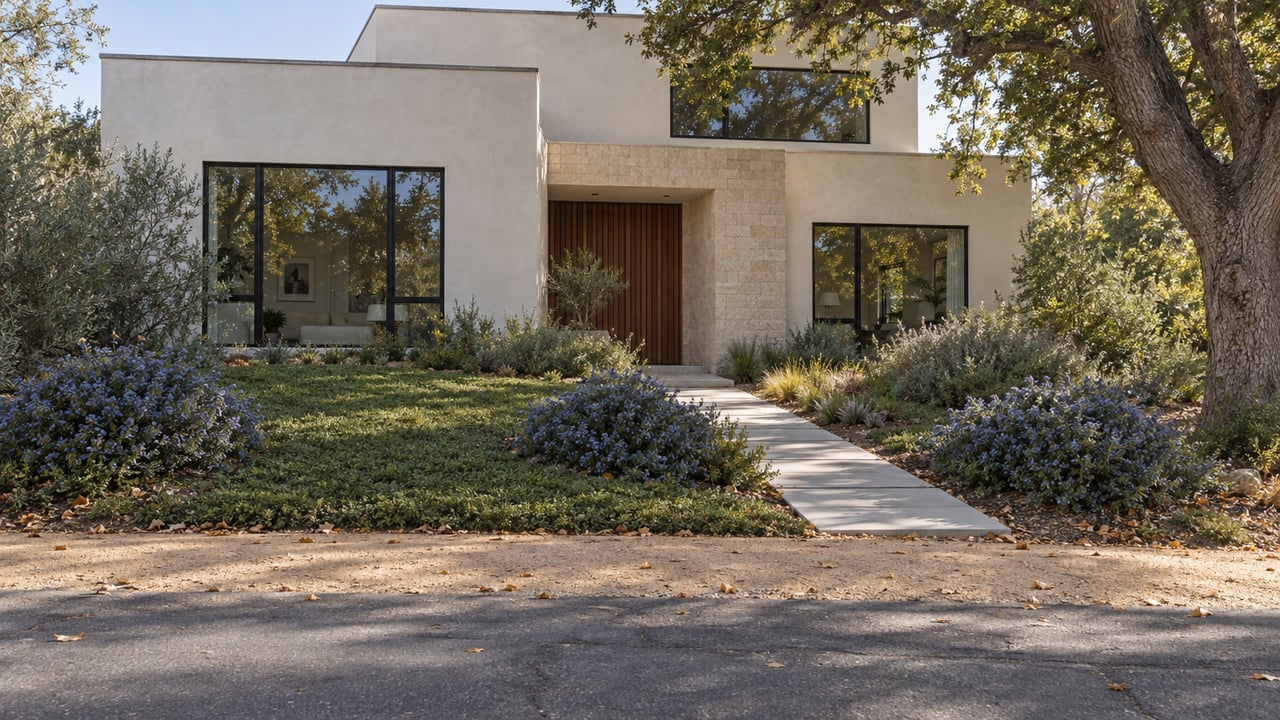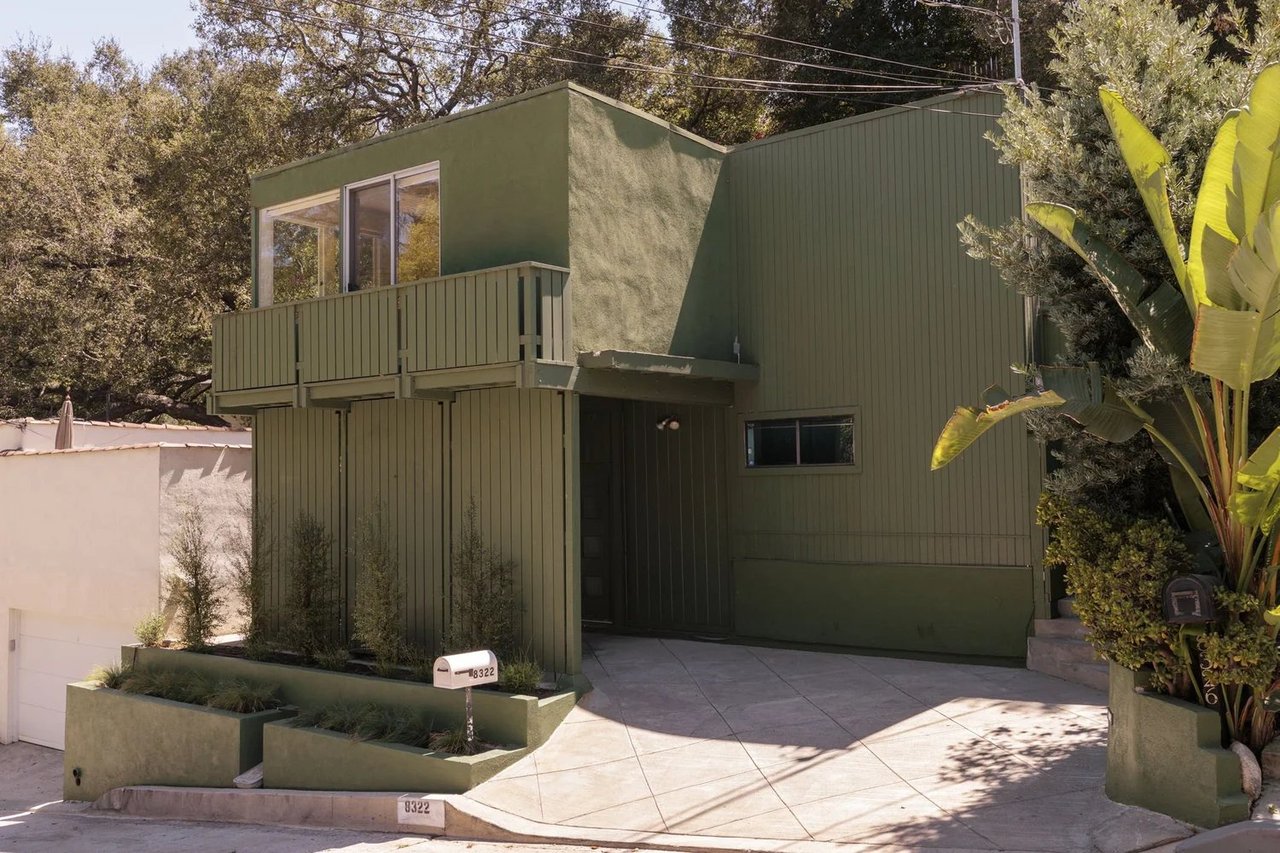
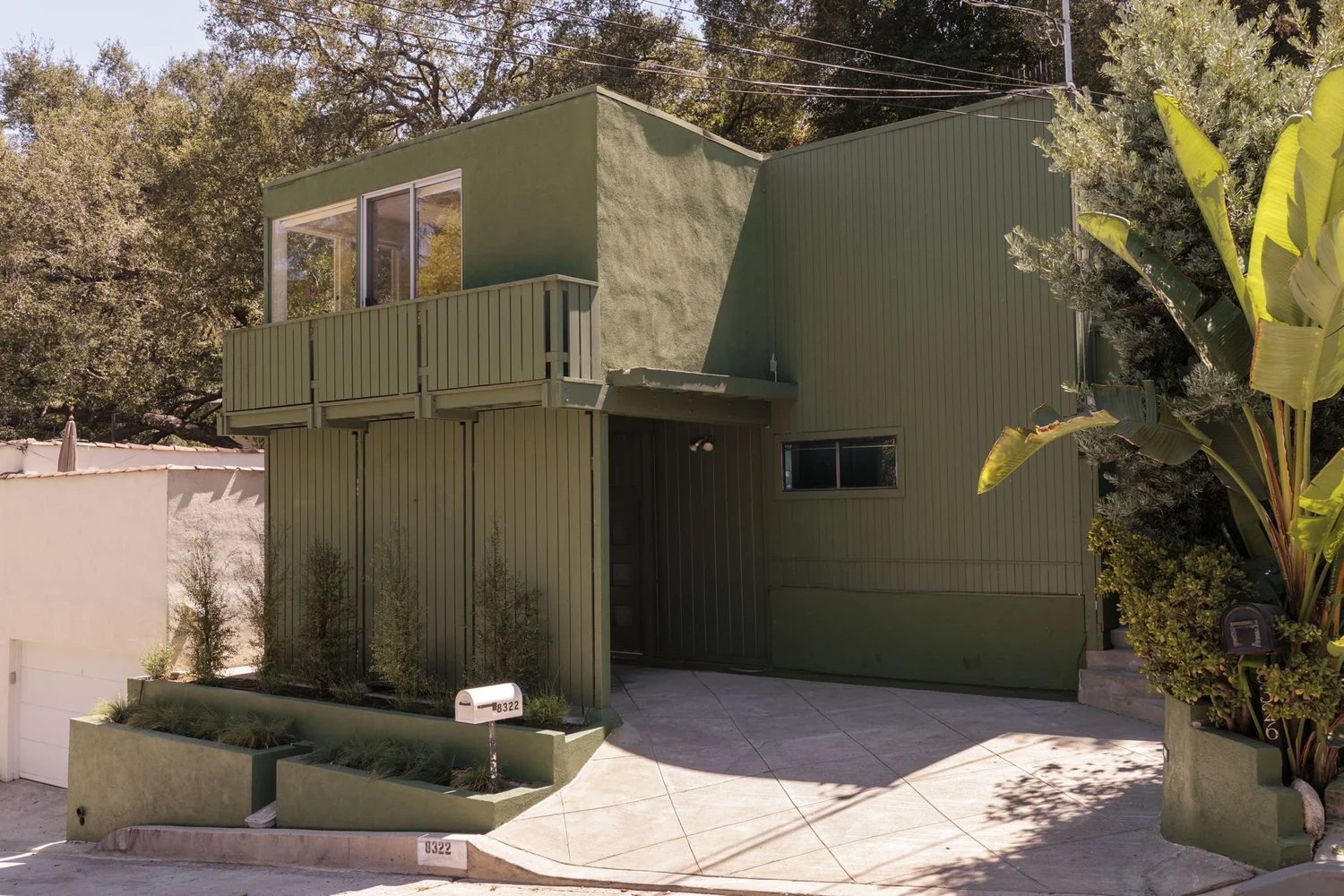
Some houses announce themselves from the street. This one would rather you didn't notice it at all. Painted the same deep green as the oaks around it, the Margaret O. Smith Residence sits on Ridpath Drive in Laurel Canyon with its upper level pushed up into the tree line, and from the curb it reads more like part of the hillside than a building on it.
It was designed in 1957 by Ray Kappe, and it's available right now, though not in the usual way. The house is listed for lease at $9,000 a month, which makes this one of the rare chances to actually live inside an early Kappe rather than admire one from a photo. For anyone who's ever wondered what a midcentury glass house feels like on a Tuesday morning, that's the whole appeal.
The listing
- Address: 8322 Ridpath Dr, Los Angeles 90046
- Rent: $9,000 per month (lease)
- Architect: Ray Kappe, FAIA
- Built: 1957
- Size: 802 sq ft, 2 bed, 2 bath
- Neighborhood: Laurel Canyon, Los Angeles
- Listed by: Drew Tietz and Todd Bachenheimer, Modern California House
Kappe, three years in
Ray Kappe is best known today as the founding director of SCI-Arc, the Southern California Institute of Architecture, which he started in 1972 with his wife Shelly Kappe, Thom Mayne, and a small group of colleagues who wanted an alternative to the traditional architecture school. Before that, in 1968, he'd been the founding chair of the architecture program at Cal Poly Pomona. By the time he died in 2019, at 92, he'd shaped a generation of Los Angeles architects.
But the teaching came later. Kappe was born in Minneapolis in 1927, moved to Los Angeles with his family in 1940, and graduated with honors from UC Berkeley's architecture program in 1951. His first job out of school was drafting Eichler Homes for the firm Anshen+Allen. He then came home to work two years with Los Angeles modernist Carl Maston before opening his own practice in 1954.
What followed was a run of dozens of custom post-and-beam houses, most of them for real clients with real budgets on difficult lots. The Margaret O. Smith Residence is part of that first wave and was built the same year as his Lowen House. It's early Kappe, which is exactly why it's interesting: you can see the ideas forming before they got big.
Small footprint, big sky
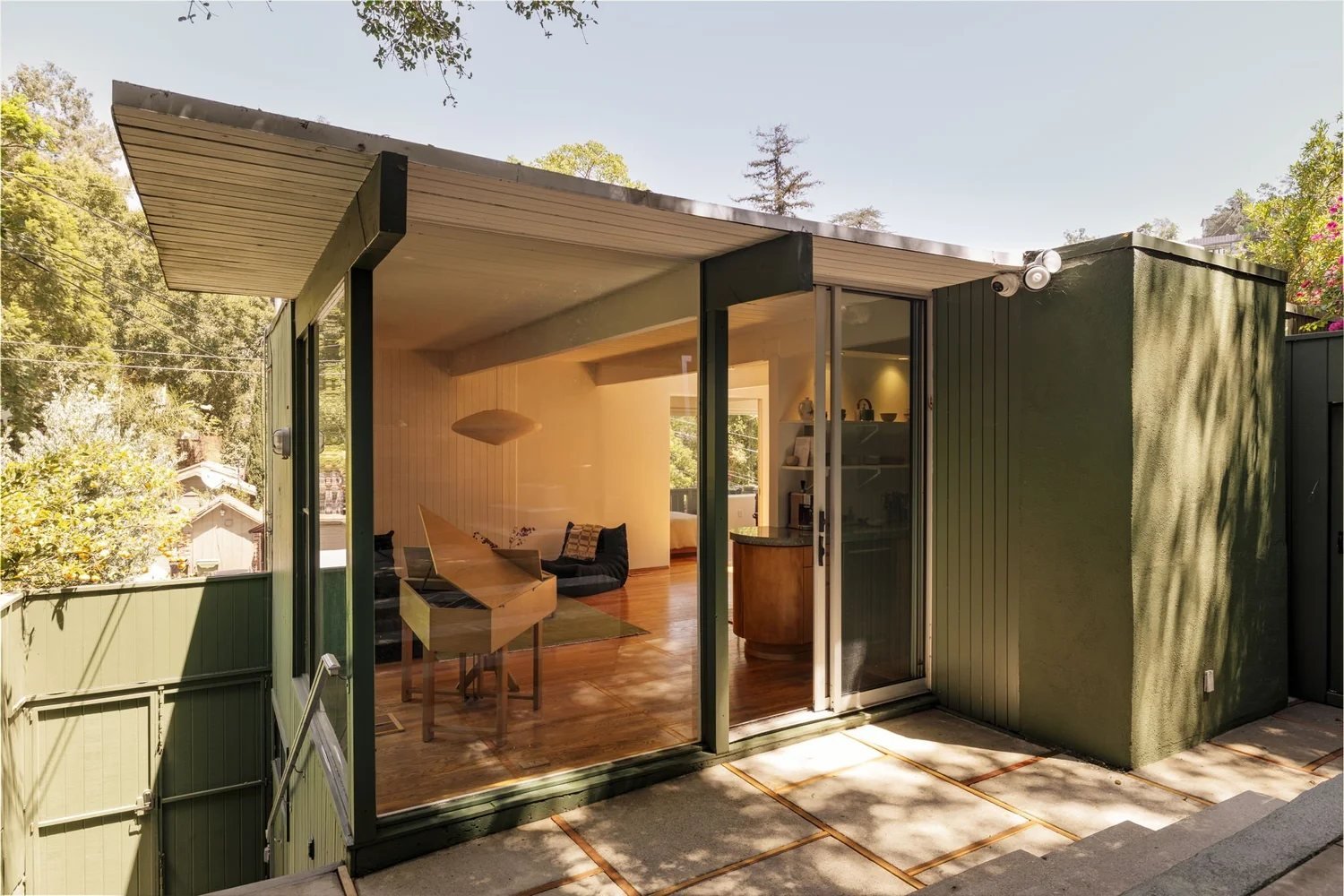
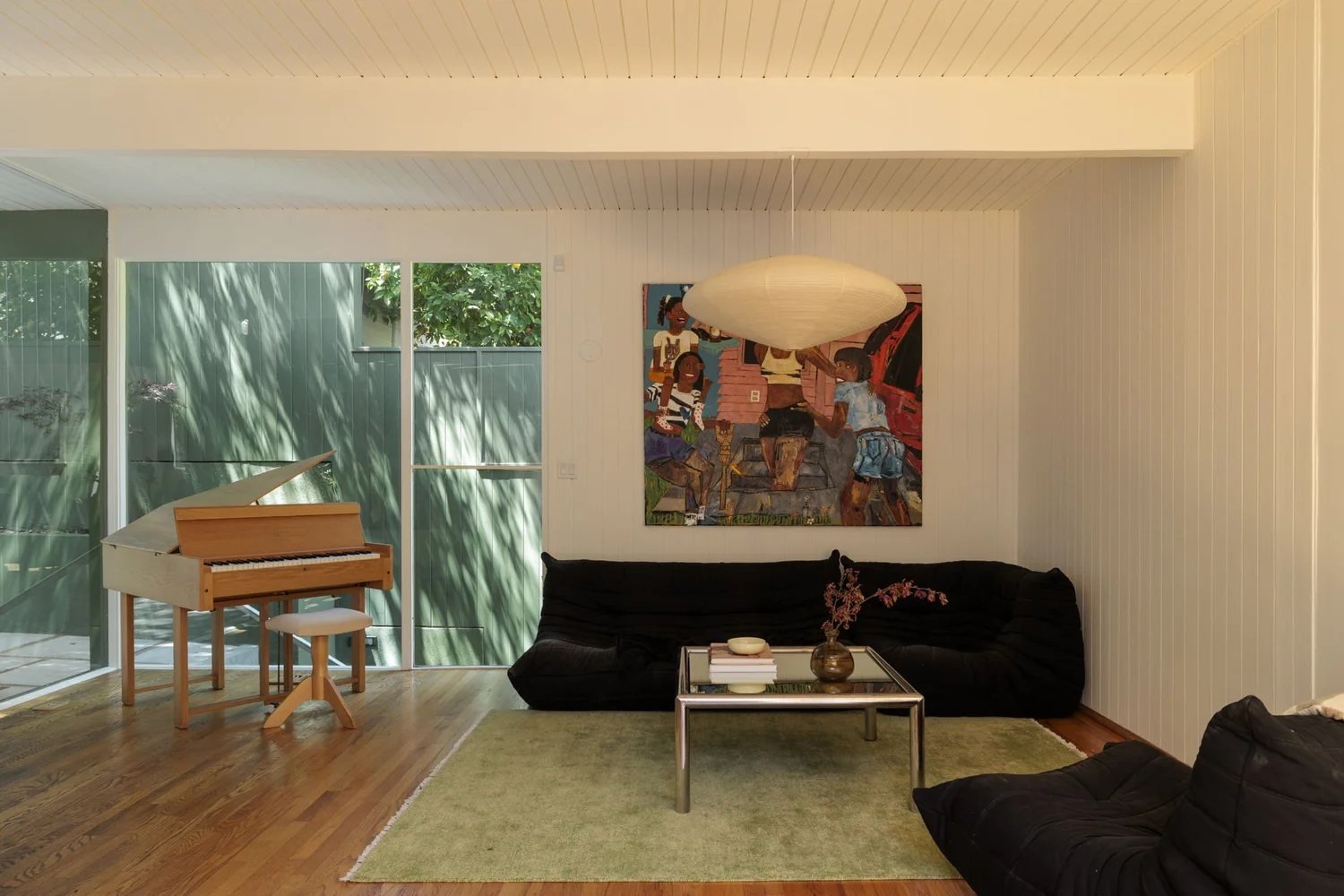
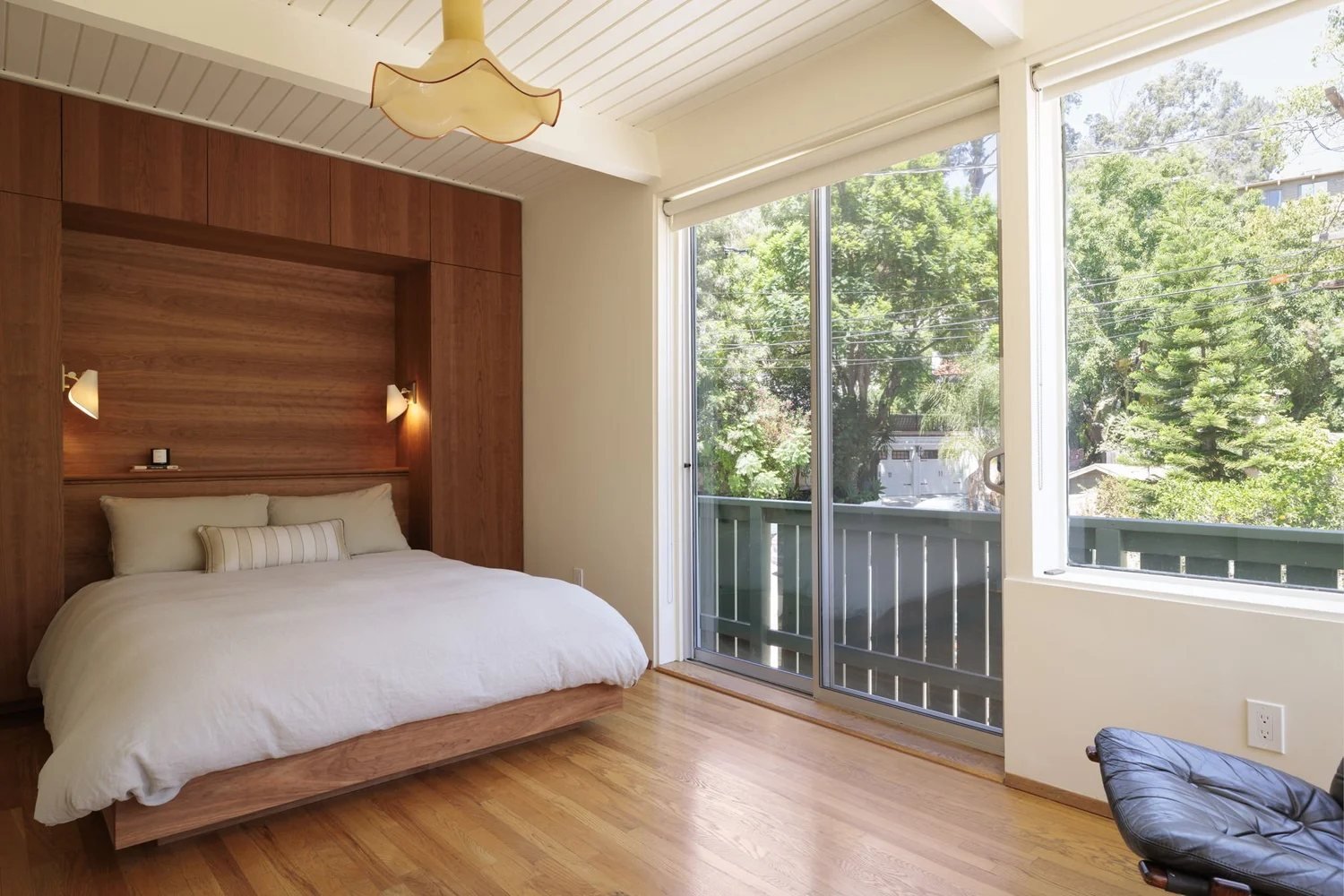
At 802 square feet, per the current listing, the house is tiny by today's standards. It doesn't feel it in the photographs, and the reason is the plan. The main level runs kitchen, dining, and living together as one open room, then lets floor-to-ceiling glass do the rest. The listing describes sunlight filtering in and throwing slow shadows across the floor through the day, and Pierre Galant's photos back that up: the light moves across white-painted ceiling boards and warm wood floors, and the canyon greenery reads as part of the room.
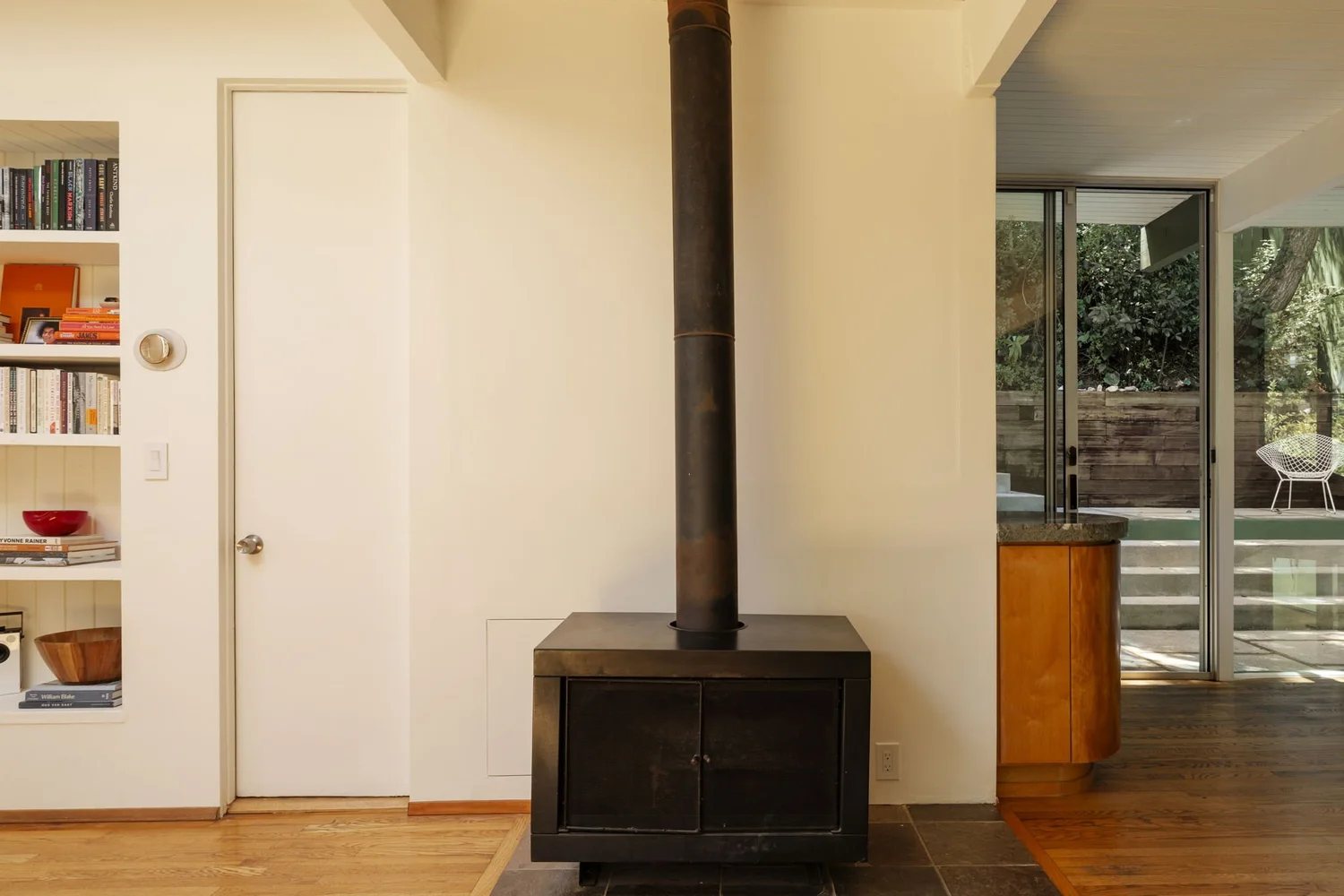
A freestanding fireplace anchors the living area, a black metal firebox with its flue running straight up to the ceiling. It's the kind of detail that shows up again and again in postwar California houses: a single object that marks the center of the room without walling anything off. The primary bedroom and a bathroom share this main floor, and the bedroom looks straight out into the tree canopy.
Downstairs, the lower level holds a laundry area, a guest bath, and a second bedroom with its own door to the outside. Two bedrooms, two baths, and a genuine separation between them in under 900 square feet is a smart piece of planning for a house this size, and it's a big part of what keeps it livable.
Laurel Canyon, on its own terms
Laurel Canyon has a reputation that arrived about a decade after this house did. The neighborhood's social center has long been the Canyon Country Store at Laurel Canyon Boulevard and Kirkwood Drive, rebuilt in brick and stone after a 1929 fire destroyed the original wooden lodge. In the 1960s and '70s it became a gathering spot for the canyon's musicians, Joni Mitchell and Carole King among them, and Jim Morrison lived just behind it on Rothdell Trail. The store even turns up in The Doors' "Love Street."
The listing puts the Smith Residence minutes from the store. What that history leaves out is the canyon itself: steep, wooded, and full of lots that don't give you much flat ground to work with. That's the site Kappe was answering here. Rather than flattening the hill, the house stacks two modest levels, pushes the main living floor up toward the light, and leaves the rest of the lot to the garden.
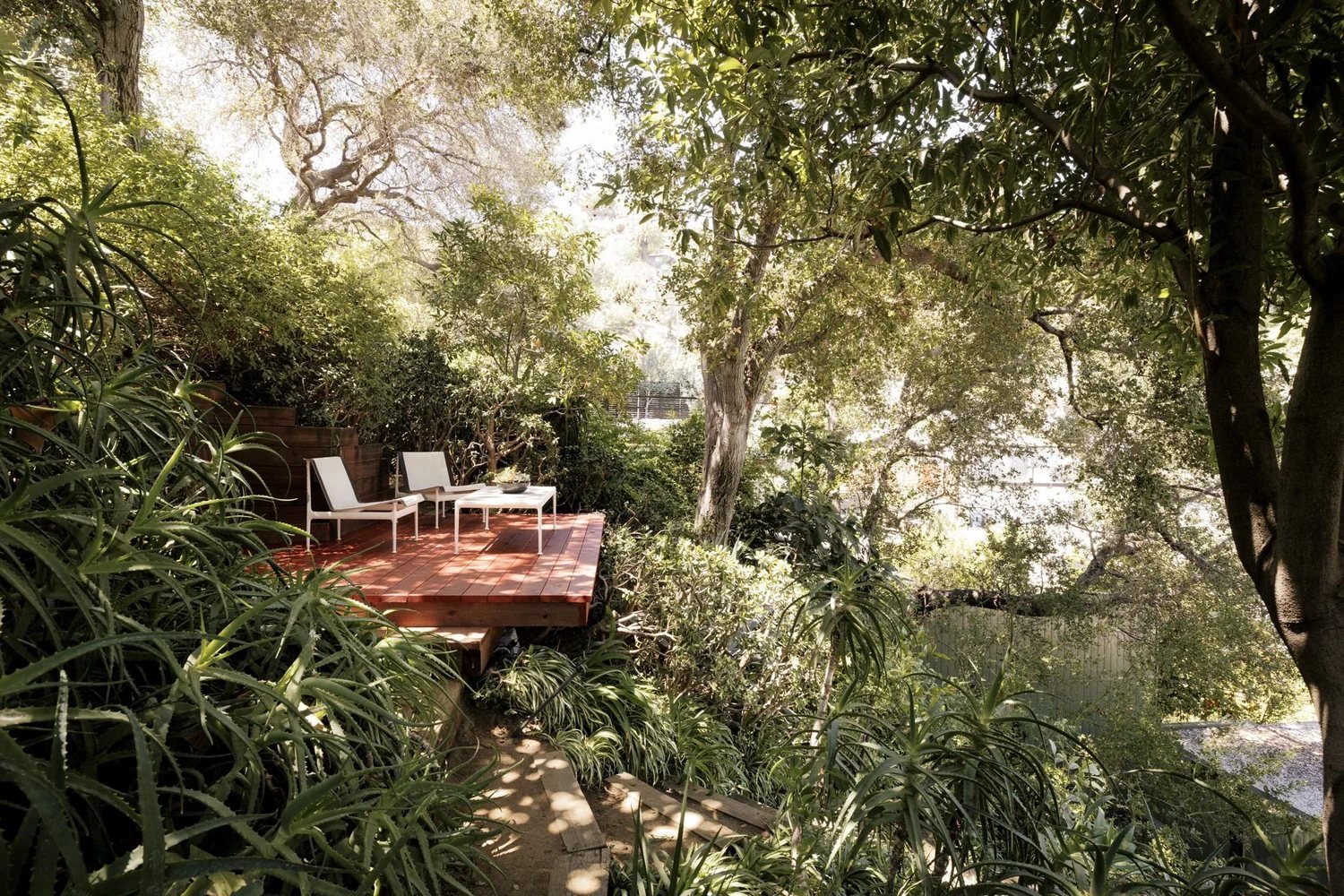
Out back, the yard is lushly planted and climbs to a raised platform deck set in the trees, a small outdoor room that feels well removed from the city even though it isn't. Between the green siding, the glass, and that deck, the whole property seems designed to make the house disappear into its setting, which is about as clear a statement of early Kappe as you'll find.
Why a lease belongs in HAUS of the Week. Most architect-designed midcentury houses change hands rarely, and when they do, buyers are often committing to a style of living they've never actually tried. A lease flips that. A year in a house like this one teaches you what 802 square feet of glass feels like in August, how a freestanding fireplace heats an open room, and whether you really want a hillside lot. That's useful knowledge for anyone thinking about a post-and-beam purchase later, whether it's in Laurel Canyon or on the coast.
The bouHAUS take
We love this house for its restraint. It isn't one of Kappe's famous later works, and it doesn't try to be. It's a young architect, a few years into his own practice, working out how to set a small, honest post-and-beam house into a difficult canyon lot and let the trees and the light carry it. The same questions come up on hillside lots up and down Southern California, including in the coastal canyons we know best, and houses like this one are still some of the best answers.
If you've been curious about living in a piece of midcentury history before owning one, this is a good place to start. And if you'd rather talk about finding a post-and-beam house of your own, you know where to find us.
Sources and credits
The Margaret O. Smith Residence at 8322 Ridpath Drive is listed for lease at $9,000 per month by Drew Tietz and Todd Bachenheimer of Modern California House. Photographs by Pierre Galant, courtesy of Modern California House.
Listing details originally published by Dwell, in "You Can Lease a Ray Kappe House in Los Angeles for $9K a Month," written by Grace Bernard. Read the original article and see the full photo gallery at Dwell.
Background on Ray Kappe from USModernist's Ray Kappe archive, SCI-Arc, and Architectural Record ("Obituary: Ray Kappe, 1927-2019," by Alex Klimoski). Canyon Country Store history from LA Weekly ("The Laurel Canyon Country Store's Interesting Musical History," by Bailey Pennick).